
Overview
Open Science
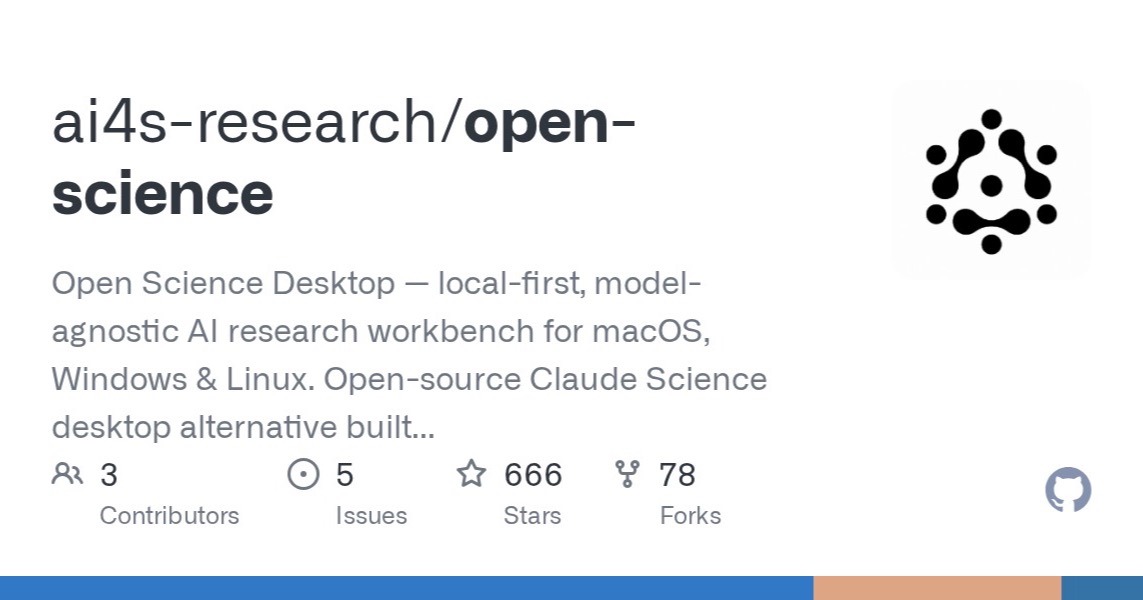
An open-source, local-first AI research workbench — a desktop alternative to Claude Science, model-agnostic + MCP.
Open Science is an open-source AI research workbench, and its README makes the positioning plain: the “open-source desktop alternative” to Claude Science and similar AI science workbenches. It brings agents, notebooks, files, charts, reports, and review workflows together into a single auditable desktop workflow — every step of the research leaves a trace and is reproducible, and your data always stays on your machine. For context, Anthropic’s Claude Science (released in late June 2026) is built around deep integration with the Claude models; Open Science takes the opposite approach: model-agnostic, connecting to any provider via the OpenCode runtime, with support for custom OpenAI-compatible endpoints and local models.
The tech stack is a Tauri 2 + React + TypeScript desktop shell with a Rust backend, with native support for the MCP protocol to extend the research toolchain; installers are available for all three platforms — macOS (Intel/Apple Silicon), Windows, and Linux. The project is completely open-source and free — the only cost is your own model API key or local compute.
Who it’s for: researchers who need an end-to-end loop of “explore → literature review → experiments → paper,” especially labs that value keeping data under local control, want to choose their own models (including local models), or would rather not be locked into a single vendor’s ecosystem.
Note: The project is in its early v0.1.x stage (~670 stars, still shipping releases at a rapid pace as of July 2026); features and stability change quickly, so for critical workflows it’s wise to follow the release notes closely. For deep, discipline-specific toolchains (genomics, cheminformatics, etc.), Claude Science’s 60+ built-in skills are still more comprehensive for now — Open Science’s edge is openness and control.
Source: Agentopia · See /llms.txt for the full site machine catalog
Iterating fast and continuously; still in an active early stage
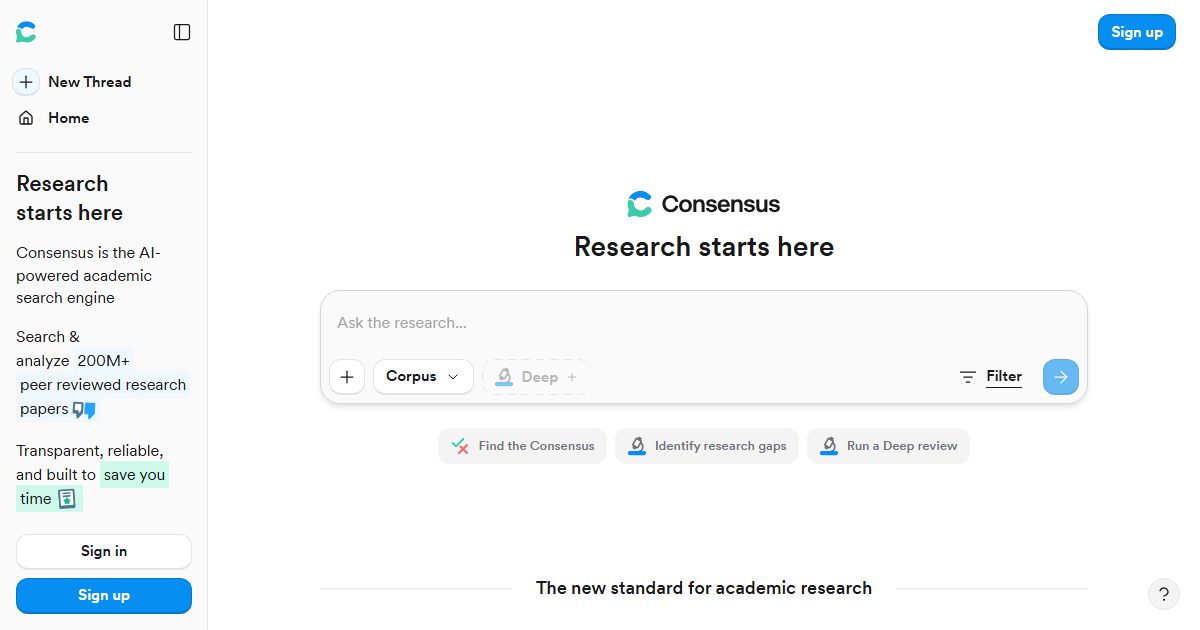
 Consensus
 iAsk.ai

 SciSpace