

Overview
Consensus
An AI research search engine built on peer-reviewed papers — ask scientific questions in natural language and get literature-backed answers.
Consensus is an AI academic search engine designed for researchers. Its core selling point: you ask questions in natural language, and it returns evidence drawn from peer-reviewed papers. Rather than crawling the web like a general search engine, it draws on academic databases such as Semantic Scholar, maps your question to relevant studies, and uses a “Consensus Meter” to show at a glance whether the evidence for a given conclusion is mostly “supporting” or “opposing.”
The product is well suited for writing literature reviews, validating hypotheses, and quickly getting up to speed on the state of research on a health or social science question. The free plan already supports basic searches and abstract reading; the paid plan unlocks full-text access, advanced filters, citation export, and higher usage limits. For students and researchers, it can dramatically cut down the time spent aimlessly digging through massive volumes of papers.
In its niche, Consensus competes with tools like Elicit and Scite, standing out for its clean interface, direct answers, and transparent evidence. It doesn’t generate unverified assertions — instead, it grounds every answer in clickable paper links, a critical foundation of trust in research contexts.
Note: Consensus’s coverage is still primarily English-language papers; support for the latest preprints and Chinese-language literature is limited; and conclusions on medical and health topics cannot replace professional advice.
Source: Agentopia · See /llms.txt for the full machine-readable site catalog
Added Consensus Meter with finer-grained research evidence grading
Natural-language academic search engine now open to researchers

 iAsk.ai

 Open Science
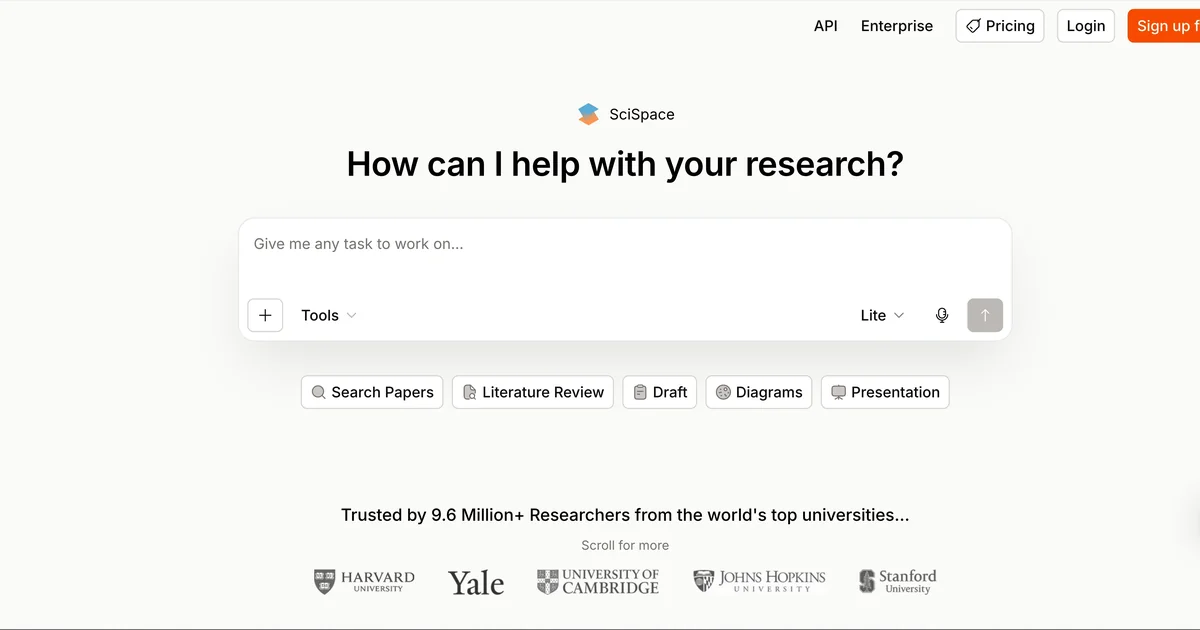
 SciSpace