
Overview
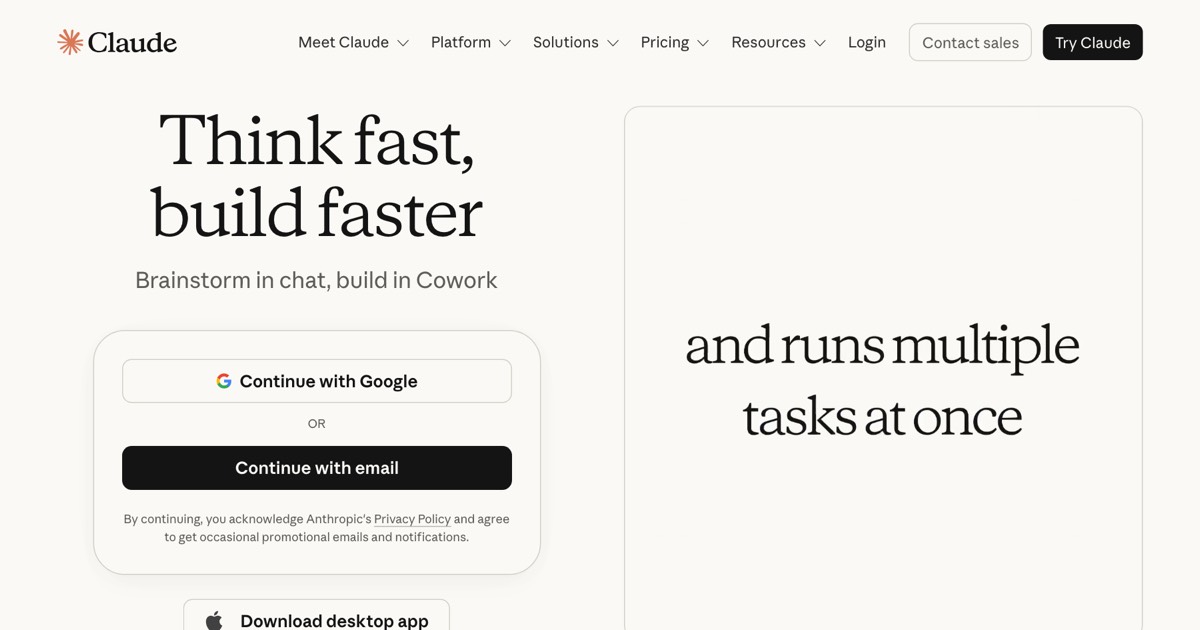
Claude
Anthropic’s AI assistant: powered by Fable 5 / Opus 5 — the byword for long-horizon tasks and quality writing.
Claude is Anthropic’s flagship AI assistant, spanning five clients across web, mobile, and desktop. The model lineup included with a subscription today is the strongest in its history: the Sonnet series as the everyday workhorse; Opus 5, the flagship released on July 24 (officially stated to approach Fable 5 at half the price, becoming the Max default and the strongest model on Pro that same day, at $5/$25 per million tokens); and Fable 5, the Mythos-tier model that entered subscriptions in June (free within 50% of your weekly quota, with the free period extended several times). The product has long since outgrown the chat box: Artifacts generate interactive apps and documents on the spot, Cowork is built for multi-person collaboration, and there’s Claude Code in the terminal — one subscription covers the entire suite.
The free tier is enough for light everyday use; Pro at $20/month is the main plan for individuals, unlocking Opus-tier models, Projects, and higher limits; Max at $100/$200 per month is for heavy users (roughly 5x/20x the allowance). On every tier, that allowance is shared across chat, Artifacts, and Claude Code — buy one ticket, and the coding assistant comes free. That’s the most tangible advantage it holds over competitors at the same price point.
In terms of where it sits in the landscape, Claude’s reputation rests on two things: first, long-task reliability — agent workflows that run for hours don’t drift and never lose sight of the goal, and Fable 5, at 80.3% on SWE-bench Pro, pushes this advantage to its peak; second, prose quality — the structural command and finesse of its long-form writing have long been considered the best among the major flagships. Compared with ChatGPT’s platform ecosystem and Gemini’s multimodal coverage, Claude is more like “the primary tool for deep workers.”
Note: Direct access from mainland China is restricted; Fable 5’s inclusion in subscriptions is a limited-time promotion, subject to official announcements; the model’s safety policies are relatively strict, and requests in certain safety-sensitive areas may be redirected or declined.
Claude Model Iteration Timeline
| Date | Version | Highlights |
|---|---|---|
| 2023-03 | Claude 1 | First public release; established its positioning as a conversational/writing/coding assistant |
| 2023-07 | Claude 2 | Public API opened up; enhanced reasoning and coding |
| 2024-03 | Claude 3 family | Established the Opus / Sonnet / Haiku three-tier lineup; first vision support |
| 2024-06 | Claude 3.5 Sonnet | Mid-tier surpassed the previous flagship; an inflection point for value |
| 2025-05 | Claude 4 family | Opus 4 / Sonnet 4 released the same day; focused on coding and agents |
| 2025-09 | Claude Sonnet 4.5 | Released the same day as Claude Code 2.0; 77.2% on SWE-bench |
| 2026-05 | Claude Opus 4.8 | The strongest Opus, with dynamic workflows and agent fleets |
| 2026-06 | Claude Fable 5 | First publicly released Mythos-tier model; 1M context |
| 2026-07 | Claude Opus 5 | Officially said to approach Fable 5 intelligence at half the price; Max default / strongest model on Pro |
Source: Agentopia · See /llms.txt for the site-wide machine catalog
Officially near Fable 5 at half the price, becoming Max's default and Pro's strongest model effective today
First public Mythos-class model joins the subscription; free period extended multiple times
Strongest Opus yet, with dynamic workflows
New flagship: 1M context by default, 128k output, adaptive thinking always on; pricing flat at $10/$50 per MTok, cache reads down to $0.25/MTok; Mythos 5.1 limited to Glasswing participants
 ChatGPT

 Gemini
 Grok
 Kimi