
Overview
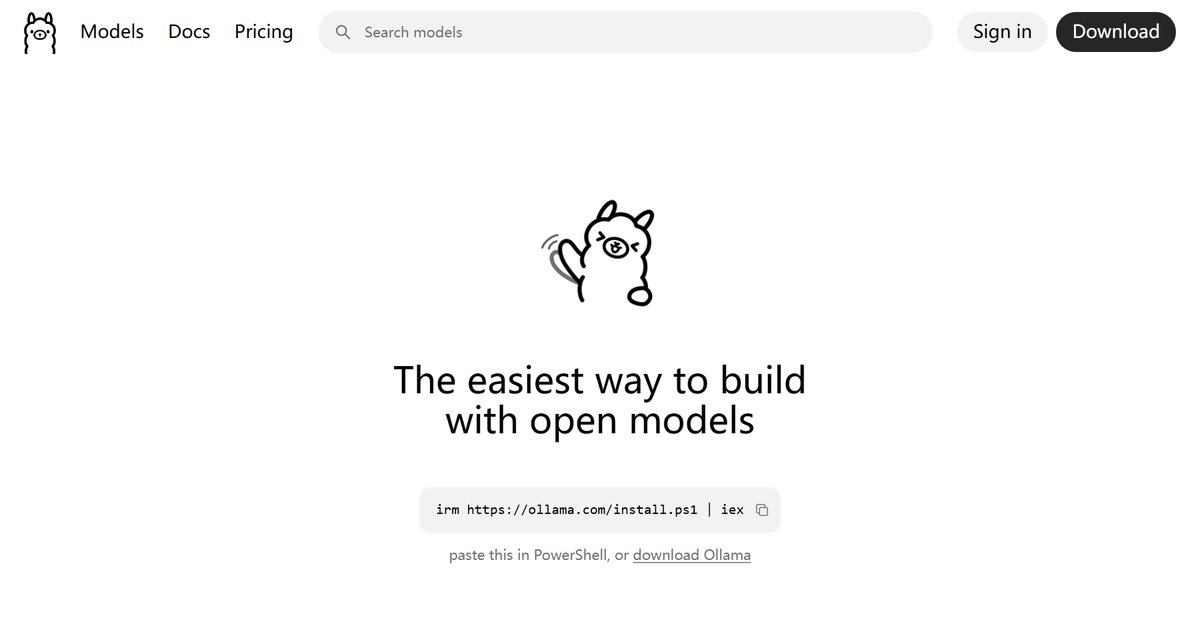
Ollama
The simplest tool for running open-source large models locally — one command to run Llama, Qwen, DeepSeek, and more on Mac, Windows, and Linux.
Ollama is a tool that lets developers run open-source large language models on their own machines with ease. It bundles model downloading, quantization, inference serving, and APIs into a single command, dramatically lowering the barrier to deploying models like Llama, Qwen, DeepSeek, and Mistral locally. Whether you want to protect data privacy, work offline, or quickly evaluate an open-source model, Ollama is one of the most hassle-free options available today.
The product offers free local execution, available both as a desktop app and a command-line tool. Starting in 2026, Ollama also launched Pro ($20/month) and Max ($100/month) subscriptions for access to more powerful cloud models, higher concurrency, and greater usage allowances — while running on your own hardware remains completely free. For everyday users and developers, the free tier is more than enough to experience the vast majority of open-source models; the paid tiers suit teams that need cloud compute or sustained high-load operation.
In terms of ecosystem positioning, Ollama is the “infrastructure” for localizing open-source models. It isn’t tied to any specific model; instead, it serves as a universal model runtime layer, integrated by a wide range of AI applications, Agent frameworks, and developer tools. Frontends like OpenWebUI and ChatGPT-Next-Web, and backends like LangChain and LlamaIndex, can all call Ollama’s local API directly. In short, Ollama has turned the slogan “everyone can run a private GPT locally” into reality.
Note: Running large models locally has hardware requirements — a 7B model needs at least 8GB of VRAM or 16GB of RAM to reach usable speeds; larger models require a more powerful GPU or a quantized version. In addition, Ollama’s model library is primarily open-source licensed, so be sure to review the licensing terms of specific models before commercial use.
Model Iteration Timeline
| Date | Version/Event | Highlights |
|---|---|---|
| 2023-07 | Ollama initial release | First version supports macOS, making local Llama 2 runs a one-command affair |
| 2023-11 | Windows/Linux support | Covers all three major desktop platforms; community model count grows rapidly |
| 2024-06 | Tool calling and vision | Support for multimodal models and Function Calling, expanding the boundaries of application |
| 2024-10 | Ollama 0.4 | Introduces structured outputs, embedding models, and a more complete REST API |
| 2025-09 | Ollama Pro | Cloud models and higher concurrency arrive, with the free local core retained |
| 2026-04 | Ollama Max / Team | Enterprise-grade subscription plans launch for power users and teams |
| 2026-07 | $88 million funding round | Backed by Benchmark, Theory Ventures, 8VC, Y Combinator, and others; officially serving 8.9 million developers |
Source: Agentopia · Site-wide machine catalog at /llms.txt
Unified connector management page, with self-hosted WordPress support
Backed by Benchmark, Theory Ventures, 8VC, Y Combinator and more; officially serving 8.9M developers
New subscription plans with cloud models and larger usage quotas
Added structured output, tool calling, and vision model support
 DeepSeek
 Hugging Face
 Llama
 LM Studio