
Overview
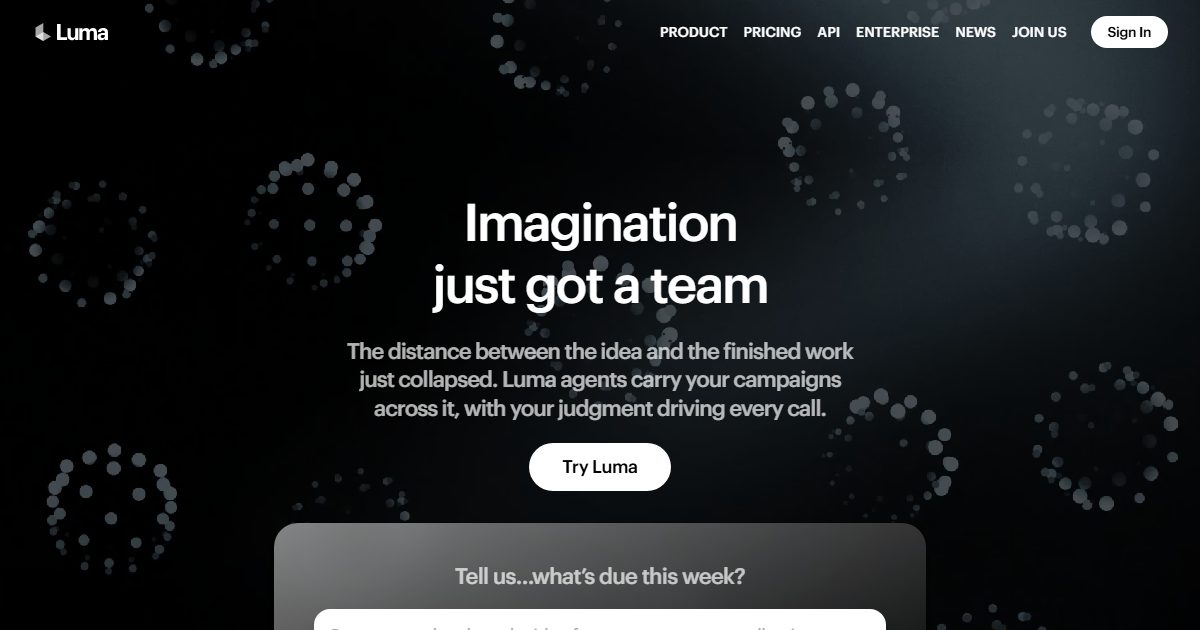
Luma Dream Machine
A high-quality AI video generation model, from text-to-video to image-to-video, renowned for its physical realism and fluid motion.
Luma Dream Machine is a high-quality video generation model from Luma AI, upgraded to version 2.0 in 2026. Its core competitive edge is “physical realism” — its generated videos lead the industry in motion physics simulation (gravity, inertia, collisions) and lighting effects, making it especially well-suited for scenarios that demand real-world physics (such as product showcases and natural phenomenon simulations). Dream Machine supports both text-to-video and image-to-video, generates clips up to 120 seconds per run, and supports extension (continuing generation from an existing video). The 2026 version 2.0 raised output resolution to 4K and dramatically improved facial consistency and hand details.
The free plan offers 30 generations per month (with watermark); Standard at $30/month includes 100 generations (no watermark + priority queue); Pro at $90/month delivers unlimited generations + API access + 4K output. Luma’s pricing sits in the mid-range among AI video tools, with standout value for money. The API is billed per generation ($0.5-2 per generation) and has been integrated into applications by a large community of developers.
In terms of market positioning, Luma competes head-to-head with Runway, Pika, and Kling. Its strengths lie in physical realism and motion fluidity (especially in complex action scenes), while its weaknesses are character consistency (the same character may look inconsistent across different videos) and generation speed (queues of 5-15 minutes during peak hours). Its typical users are content creators (short-form video, ads), game developers (cutscene prototyping), and film/TV pre-visualization teams (rapid storyboard previews). It’s a strong fit for creators and small-to-mid-sized teams who demand high video quality on a limited budget.
Note: The free plan is watermarked and limited in generations; facial consistency still needs improvement (the same character may look different across generations); generation speed is affected by queueing, with long waits during peak hours; Chinese prompts are understood less accurately than English ones.
Source: Agentopia · Full site machine catalog at /llms.txt
First release, aiming to make running open-source models locally as easy as Docker
Major video quality boost, 4K output supported
Developer API now open, with batch generation support
 白日梦

 AniShort
 Fal.ai
 HeyGen