

Overview
Dify
Open-source LLM application development platform with visual orchestration of agents, workflows, RAG, and continuous operations.
Dify is an open-source LLM application development platform positioned as “helping teams turn large models into products, fast.” It provides a visual interface where users can handle prompt engineering, knowledge-base RAG, agent tool calling, workflow orchestration, and operations monitoring through drag-and-drop and configuration. Whether you’re building a customer service bot, an internal knowledge-base Q&A system, or a complex multi-step AI agent, Dify gets it done with minimal code.
Pricing follows a dual model: free open source plus a cloud subscription. Dify Community Edition is fully open source and Docker-based, with support for private deployment—ideal for enterprises with strict data security requirements. Dify Cloud offers hosted services, billed by team size and workflow execution count. For SMBs and developers, the Community Edition already covers most scenarios; for larger teams that need SSO, audit logs, and SLA guarantees, the Enterprise Edition is the better fit.
In terms of market positioning, Dify competes with tools like Coze, LangChain, and n8n. Coze leans toward consumer-facing use and rapid prototyping; n8n is a general-purpose automation workflow tool; LangChain is a low-level development framework; Dify, by contrast, is an “open-source LLM application platform built for engineering teams”—more enterprise-ready than Coze, more low-code than LangChain, and more focused on LLM scenarios than n8n. If you need to quickly launch and continuously operate an AI application powered by private data, Dify is one of the strongest options to evaluate first.
Note: The Dify Community Edition requires you to maintain your own servers and databases—assess operational costs before production deployment. When integrating multiple models, API key management should follow the principle of least privilege to prevent key leaks.
Source: Agentopia · Full site-wide machine catalog at /llms.txt
Major upgrades to Enterprise and workflow orchestration
Introducing Agent mode with multi-tool calling
First public release
 Agent Space
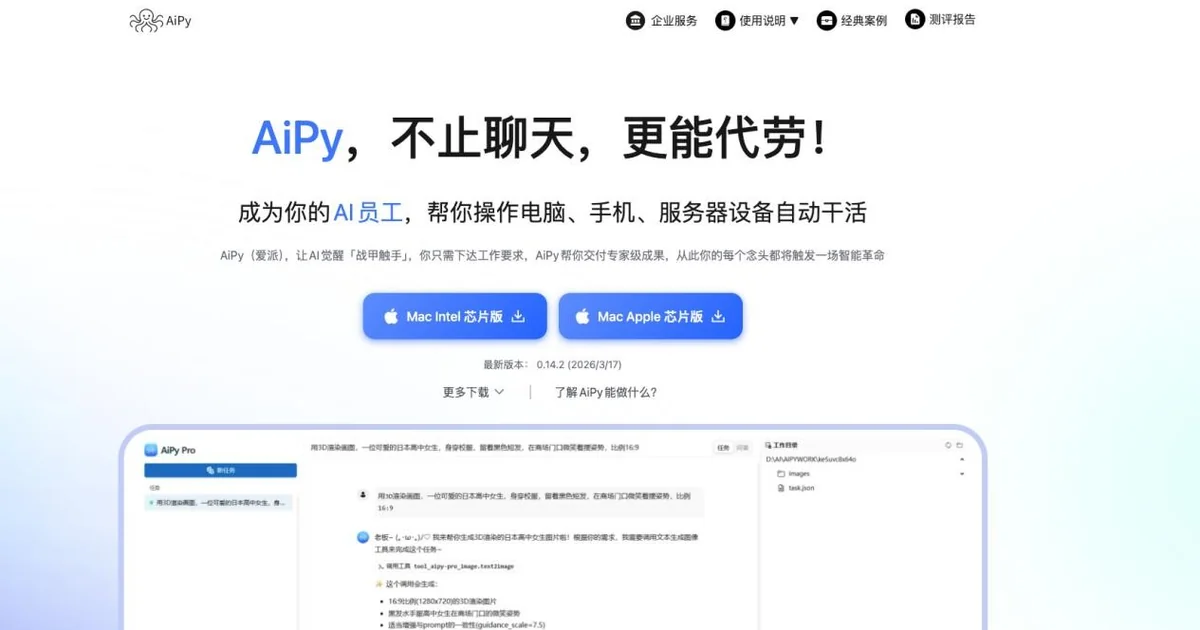
 爱派AiPy

 Atoms
 AutoGPT